

Jason Dale, MPA, M.Phil, ABD (PhD Candidate 2027) brings 25 years of real California field experience into every class. He spent his career in the toughest armed assignments, Sex Crimes, Domestic Violence, and the Anaheim PD TARGET Gang Unit. So the scenarios, case law, and tactics he teaches are grounded in reality, not theory.
Agencies choose Jason because his courses solve actual problems. Every training is built around liability reduction, officer safety, trauma management, decision-making, and clean documentation. Departments consistently report better performance, fewer complaints, and more confident staff after their sessions.
Jason is STC-certified and trusted statewide. He has trained officers in 15 counties across California, delivering content that meets STC and BSCC standards while staying practical, modern, and immediately usable.
His energy, clarity, and experience make the difference. Jason teaches the way officers learn best: direct, relatable, scenario-based, and grounded in what actually happens on the street, in the field, in homes, and in court.
If you want training that elevates performance, strengthens judgment, and protects staff and departments, Jason delivers it.

Choose in-person or online training that fits your schedule, ensuring accessible, practical education anytime, anywhere.

Learn from seasoned professionals who provide real-world insights, mentorship, and actionable strategies for immediate application.
Cert # 06459817 Officers practice structured, calm, and clear verbal interventions to set limits and address non-compliance before problems escalate. The course teaches language, tone, body positioning, and follow-through that preserve safety, respect, and authority without unnecessary force.
Cert # 09919461 This 8-hour instructor-led course examines how survival stress affects the body and brain and shapes officer performance during field contacts, home visits, and high-risk supervision. Using a neurobehavioral lens, participants learn how the autonomic nervous system, stress hormones, and key brain systems (prefrontal cortex, midbrain, and amygdala) affect perception, heart rate, vision, hearing, fine motor skills, and decision speed. Officers map the contact–escalation cycle (approach, assessment, engagement, escalation/assault, survival response, aftermath), distinguish compliant, resistant, and assaultive patterns, and apply threat-assessment models (Cooper Color Codes, OODA Loop, pre-attack indicators / “Left of Bang,” and contact-and-cover) to realistic scenarios. The course emphasizes early recognition of high-risk conditions, reduced officer-created jeopardy, and structured tactical responses that balance officer survival, public safety, legal defensibility, and documentation.
Why Departments Book This Course
Departments book this course because field contacts, home visits, and high-risk supervision are among the most liability- and stress-intensive activities in probation and corrections. Survival stress can rapidly degrade perception, decision-making, and fine motor performance, increasing the risk of officer-created jeopardy, delayed recognition of pre-attack indicators, and incomplete or indefensible documentation. This course gives officers and supervisors a practical framework for recognizing how the body and brain respond under threat, mapping the full contact–escalation cycle, and applying proven threat-assessment models before force becomes necessary. The result is improved officer safety, more consistent and legally defensible responses, reduced exposure to critical incidents, and better operational outcomes during routine and high-risk supervision.
Cert # 07778298 This training is designed to strengthen critical incident response, report-writing quality, documentation consistency, and legal defensibility for probation and correctional staff. The course focuses on officer-level response decisions, scene safety, evidence preservation, public safety statement boundaries, medical aid documentation, chronological writing, behavior-based language, and final report preparation.
Participants will practice documenting what occurred, what they personally observed and perceived, what they knew at the time, what decisions they made, what actions they took, why those actions were reasonable, whether they were within policy, and why immediate action was necessary under the circumstances.
Why Officers Need This Training
Probation and correctional officers are often required to make fast decisions during high-risk, rapidly evolving incidents where safety, accountability, and legal scrutiny intersect. This training gives officers practical tools to respond appropriately, document accurately, and clearly explain what they saw, knew, perceived, decided, and did at the time of the incident.
Strong critical incident documentation protects staff, supports agency transparency, preserves evidence, strengthens report credibility, and helps demonstrate that officer actions were reasonable, necessary, and within policy.
Cert # 07943886 Critical Incident Report Writing for Supervisors is an 8-hour instructor-led course designed for supervisors and public safety leaders responsible for reviewing, coaching, and strengthening critical incident reports. The course briefly addresses immediate response considerations, including scene safety, evidence preservation, notifications, and public safety statement boundaries, before focusing on final report preparation and supervisory review.
Participants will learn how to evaluate reports for factual accuracy, chronological clarity, behavior-based language, policy connection, reasonableness, imminence, California POBR considerations, and overall legal defensibility. The training emphasizes how supervisors can help ensure reports clearly explain what occurred, what staff knew and perceived at the time, what decisions were made, why actions were reasonable, and how documentation supports accountability, consistency, and agency protection.
Why Supervisors Need This Training
Supervisors play a critical role in ensuring that critical incident reports are accurate, complete, consistent, and defensible before they move forward through the agency review process. In high-liability incidents, weak documentation, unclear articulation, missing facts, or inconsistent report language can create unnecessary risk for staff, supervisors, and the agency.
This training gives supervisors practical tools to identify documentation gaps, coach officers on report quality, connect actions to policy and legal standards, and ensure reports clearly explain what occurred, why decisions were made, and why actions were reasonable under the circumstances. Strong supervisory review improves report credibility, strengthens accountability, supports transparency, and helps protect both staff and the organization.
The Officer is the Key – Foundations of Behavior Change (MI + EBP)
Real behavior change happens through effective officer interactions, not just rules or sanctions. Learn how conversations influence motivation, reduce resistance, and improve compliance. Apply practical MI-based communication techniques, structured contact strategies, and real-time decision skills to strengthen client commitment and outcomes.
Cert # 00432587 This 8-hour, instructor-led course equips correctional officers and field supervision staff with a practical framework for influencing behavior while maintaining authority, safety, and accountability. Participants learn how behavior change actually occurs in justice settings, why some traditional supervision tactics increase resistance, and how officer communication, structure, and consistency directly shape compliance, engagement, and outcomes. The training emphasizes a clear contact structure that can be applied during intake, violations, relapse, noncompliance, and high-emotion encounters.
Motivational Interviewing is taught as an operational supervision tool—not therapy—to reduce defensiveness, prevent power struggles, and elicit clear client commitments. Through realistic scenarios, role-plays, and applied skill practice, staff learn techniques that increase cooperation without weakening enforcement authority. Officers leave with concrete communication tools, scripts, and documentation strategies that support follow-through, professional rapport, and defensible decision-making in both custody and community supervision environments.
• 8-hour, instructor-led training for custody and field staff
• Teaches how behavior change and compliance actually develop
• Provides a structured contact model for high-impact supervision moments
• Uses MI as an operational tool to reduce resistance and escalation
• Strengthens authority while improving cooperation and engagement
• Scenario-based practice with field-ready communication tools
• Improves documentation and defensibility of supervision actions
Cert # 04012059 Dialectical Behavior Therapy (DBT) Skills for Effective Supervision provides probation officers, correctional officers, supervisors, and managers with practical, evidence-informed tools to improve communication, reduce conflict, strengthen accountability, and support behavior change among justice-involved individuals. Participants learn how to apply the four core DBT skill domains, such as Mindfulness, Distress Tolerance, Emotion Regulation, and Interpersonal Effectiveness, to supervision contacts, crisis situations, field contacts, institutional interactions, and behavior-change conversations. Through scenario-based learning, case studies, role-play exercises, and structured group activities, officers develop practical skills that improve officer safety, reduce escalation, increase compliance, and strengthen professional interactions.
Why Officers Need This Course
Probation and correctional officers routinely supervise individuals struggling with trauma, substance abuse, mental illness, impulsivity, emotional dysregulation, antisocial thinking patterns, and poor coping skills. These factors often contribute to resistance, manipulation, noncompliance, institutional misconduct, and supervision challenges. DBT provides officers with practical tools to recognize emotional escalation, respond effectively to difficult behavior, reinforce accountability, improve communication, and support positive behavior change while maintaining officer authority and public safety. The course complements Evidence-Based Practices (EBP), Risk-Need-Responsivity (RNR) principles, and Motivational Interviewing (MI), giving officers another effective tool to improve supervision outcomes, documentation, officer safety, and public safety.
Cert # 09404725 This 8-hour instructor-led course examines how implicit bias, cognitive biases, and the bias blind spot influence the perceptions and decisions probation officers make in field and community supervision settings. Participants learn how automatic associations form, why even well-intentioned officers can underestimate their own biases, and how these patterns
can affect assessments, contacts, responses to violations, report language, and recommendations. The training moves beyond awareness alone and focuses on practical application. Officers learn to apply the four pillars of Principled Policing (Voice, Neutrality, Respect, and Trustworthiness), strengthen cultural competency in Community Policing approaches, and use Beyond Bias techniques that support fair and impartial responses under pressure. The course emphasizes realistic scenarios, structured decision-making, and personal action planning that improve professional judgment, strengthen legitimacy, and support officer safety.
Why Departments Book This Course
Departments book this course because implicit bias and the bias blind spot can quietly shape high-stakes decisions, assessments, contacts, violation responses, report language, and recommendations, even among well-intentioned officers, creating risks to legitimacy, community trust, and officer safety. Awareness training alone rarely changes behavior under real- world pressure. This course provides officers and supervisors with practical tools grounded in Principled Policing and Beyond Bias techniques, enabling them to recognize bias at decision
points, apply structured approaches that support fairness and neutrality, and maintain professional effectiveness in the field. The result is more consistent and defensible decisions, stronger
community relationships, reduced liability exposure, and improved officer safety during community supervision.
Cert # 08782400 Officers learn how trauma shapes brain development, behavior, and compliance. Using a trauma-informed lens, participants practice adjusting expectations, responses, and interventions to reduce re-traumatization, support safety, and still maintain accountability.
Cert # 03185712 This course turns the trauma-informed lens back toward staff. Officers examine the impact of chronic exposure to others’ trauma, learn tools for processing and peer support, and develop personal and organizational strategies to reduce burnout, cynicism, and turnover.
Cert # 05178723 Officers learn how crime impacts victims across various domains, including emotional, physical, financial, and relational. The course emphasizes best practices for communication, referral, documentation, and collaboration with victim services, aiming to enhance victim safety, voice, and long-term survivorship.
The emphasis is on matching response to functional capacity and risk, not defaulting to one style of intervention.
Distinguishing Mental Illness, Substance Effects, Personality-Driven Conduct, and Imminent Threat Under Field and Custody Conditions
Frontline personnel increasingly encounter individuals whose behavior is driven by overlapping mental illness, stimulant psychosis, opioid effects, trauma, extreme stress, or personality pathology. These presentations can appear similar on the surface but require fundamentally different tactical responses.
Misidentifying the behavioral driver can lead to inappropriate force, missed medical emergencies, preventable assaults, or catastrophic incidents.
This advanced operational course trains officers to rapidly determine what is happening, how dangerous it is, and the appropriate response strategy, before the situation deteriorates.
Unlike communication-focused training, this program centers on threat recognition, behavioral interpretation, and decision-making under uncertainty.
Participants learn a structured framework to evaluate:
Why Agencies Book This Course
Most critical incidents are preceded by behavioral warning signs that were present but not correctly interpreted. This course equips staff to recognize those signals and act decisively before conditions deteriorate.
It is designed for agencies that want personnel capable of managing complex human behavior without sacrificing authority, safety, or accountability
Cert # 07142926 Code of Silence: Integrity in Practice: Ethics, Public Corruption, and the Duty to Report examines how professional loyalty, workplace culture, fear of retaliation, and distrust of reporting systems can discourage public-safety employees from speaking up about misconduct. The course connects ethical decision-making to the oath of office, legal reporting duties, whistleblower protections, public corruption laws, use-of-force responsibilities, documentation standards, and supervisory accountability. Through probation-specific case studies and scenarios, participants learn to distinguish mistakes from misconduct, separate facts from assumptions, preserve evidence, report concerns through appropriate channels, and act before silence becomes complicity.
Why Officers Need this Course
Probation work depends on trust: courts, the public, and colleagues assume officers will tell the truth, document what happened, and not look the other way when someone crosses the line. The code of silence still puts that at risk. Loyalty to the team, fear of being labeled a snitch, and weak or unsafe reporting systems can keep officers quiet about misconduct until a mistake becomes a scandal, a lawsuit, or a compromised case. This course is needed because officers must know the difference between a performance error and reportable misconduct, how to separate fact from rumor, and how to use the right channel before silence turns into complicity. It gives them a practical way to honor the oath, protect themselves and the agency, and keep workplace culture from overriding the duty to report.
Cert # 06593897 Drug Recognition for Probation & Corrections is an 8-hour instructor-led STC course that prepares adult and juvenile field officers, custody staff, supervisors, and lead personnel to recognize illicit and street drugs encountered during field contacts, searches, home visits, transportation, intake, and custody operations. Participants learn major drug categories, including opioids such as heroin, illicit fentanyl, and xylazine/tranq; stimulants; cannabis and concentrates; depressants; dissociatives; hallucinogens; synthetics; adulterants; and polysubstance combinations, then classify behavioral, physical, and environmental indicators while distinguishing influence, overdose, withdrawal, and possible medical or behavioral-health crisis. The course emphasizes objective observation rather than unsupported diagnosis, applies fentanyl- and xylazine-safety considerations and naloxone considerations, and trains officers to articulate findings in defensible language for case notes, incident reports, referrals, and testimony. Applied exercises, field and custody scenarios, and documentation drills connect recognition to proportionate decisions regarding safety, supervision, custody, medical care, and notification in accordance with agency policy.
Why Officers Need this Course
Field and custody officers run into drugs they were never trained to name, let alone describe safely or in writing. Fentanyl, xylazine, synthetics, and mixed-use combinations change how someone looks, acts, and crashes, and a wrong read can mean a missed overdose, an unnecessary use of force, or a report that will not hold up. This course is needed because recognition has to be faster and more precise than “they look high.” Officers need to separate influence, withdrawal, overdose, and medical crisis, protect themselves during searches and transports, and put what they saw into defensible notes, referrals, and testimony. That keeps staff safer, ensures the right medical response arrives sooner, and supports supervision decisions that align with policy rather than guesswork.
Cert # 07894112 Officers examine the risk factors, offense cycles, and treatment considerations unique to juvenile and adult sex offenders. The course emphasizes containment-model principles, collaboration with treatment providers, polygraph and digital monitoring issues, and victim-centered supervision strategies.
Cert # 04707838 Leadership is not about rank; it is about influence, credibility, communication, and the daily behaviors that shape workplace culture. This course helps officers, supervisors, lead staff, managers, and aspiring leaders understand how they can lead effectively from any position in the organization. Participants learn how to build trust, communicate expectations, model professionalism, strengthen accountability, reduce negativity, and turn passive compliance into active engagement.
Why officers need this course
Officers need this course because every probation professional has influence, whether they supervise staff or not. The way officers communicate with peers, supervisors, clients, families, court partners, and community stakeholders directly affects morale, safety, accountability, and outcomes. When staff understand how to lead with credibility rather than title, they are better prepared to support the mission, solve problems professionally, improve team culture, and drive positive change within the department.
Cert # 07634164 Is an 8-hour leadership course for public-safety supervisors focused on rebuilding trust, clarity, and communication under stress. Grounded in Extreme Ownership principles, participants learn to identify toxic culture patterns, replace blame with ownership, and build psychologically safe communication norms that hold up during staffing shortages, overtime, and crises. Through facilitated discussion, case analysis, and practical exercises, leaders practice ego-check resets, SBAR-based directive writing, stronger up-and-down feedback loops, and reflective listening across divisions. The course closes with an actionable culture-shift plan including daily communication rituals, ownership pledges, and 90-day accountability commitments.
Cert # 07978634 Promotional Readiness & Oral Board Preparation for Probation Leaders (8 Hours | ILT)
Promotional panels reward candidates who can think, communicate, and lead under pressure, not those who memorize scripts. This course prepares probation professionals to perform at a supervisory level during oral boards and assessment exercises.
Training is scenario-driven and built to mirror real promotional processes. Participants complete mock oral boards, leadership decision scenarios, and group problem-solving, aligned with the competencies panels’ scores: judgment, policy application, command presence, ethics, and composure. Candidates are video-recorded and receive structured feedback to quickly improve clarity, delivery, and leadership presence.
Departments benefit from candidates who can articulate defensible decisions, communicate professionally, and demonstrate readiness for supervisory responsibility—skills that transfer directly to supervision, critical incident decision-making, and risk management.
Course methodology includes:
Mock oral boards with structured scoring
Scenario-based leadership exercises
Group problem-solving tasks
Time-pressured decision scenarios
Video-recorded responses with playback review
Immediate coaching and peer feedback
Cert # 07180343 This course is inspired by Extreme Ownership by Jocko Willink and Leif Babin, co-founders of Echelon Front and authors of the widely recognized leadership framework built around accountability, mission focus, communication, teamwork, humility, and disciplined execution. In Extreme Ownership, Willink and Babin teach leaders how to take responsibility for outcomes, build belief in the mission, check the ego, lead up and down the chain of command, and empower teams through decentralized command.
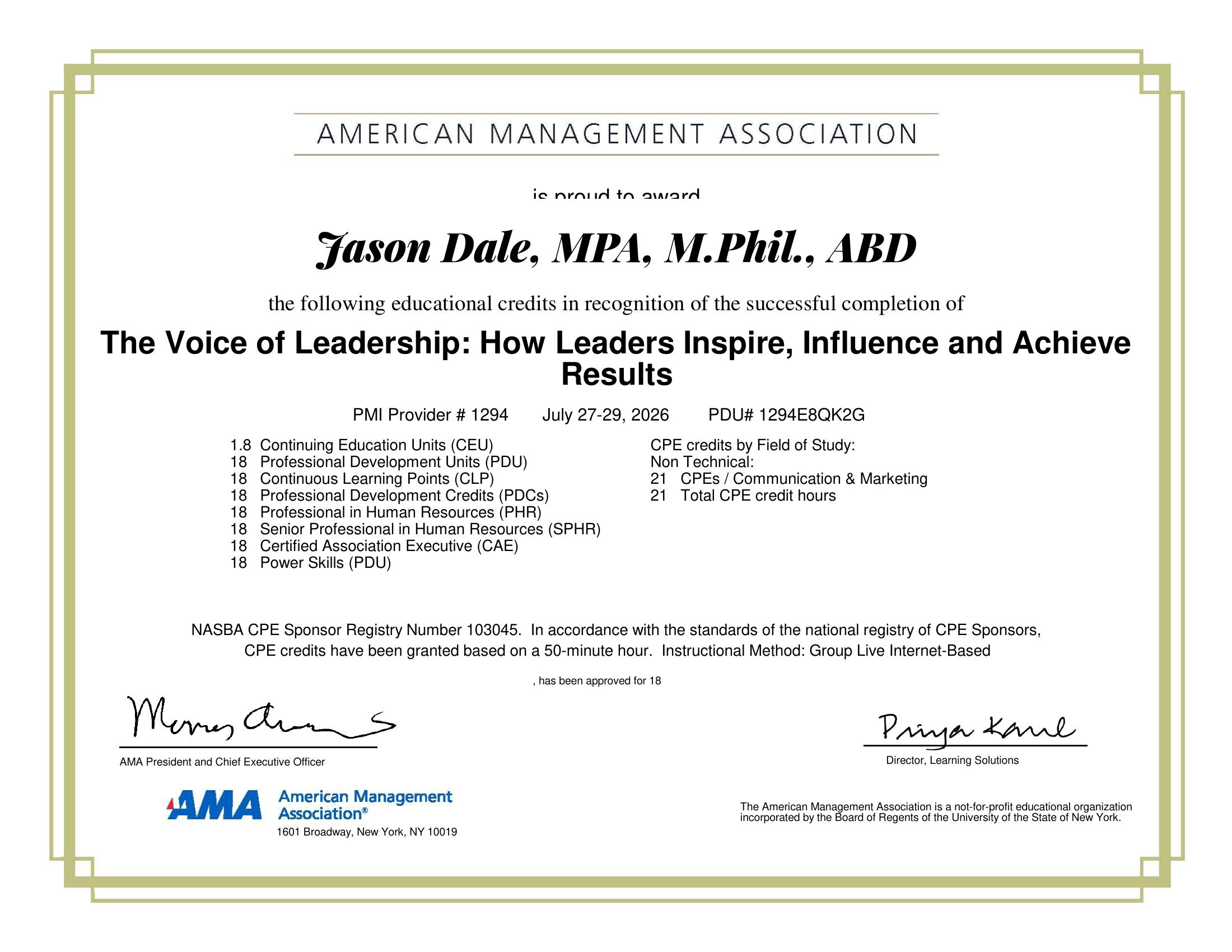
Jason Dale, owner and lead instructor of NexGen Training Solutions, attended the three-day Echelon Front Leadership Academy in San Diego in July 2026 to learn these leadership concepts firsthand from Jocko Willink, Leif Babin, and the Echelon Front leadership team. This course brings those leadership principles into the probation environment by connecting the lessons of military and organizational leadership, along with field-tested decision-making, to the real-world challenges faced by probation professionals.
Participants will examine how ownership-based leadership applies to probation work, where officers, supervisors, managers, and executives must take responsibility for communication, expectations, documentation, officer safety, public safety, staff development, unit culture, mission alignment, and client outcomes.
Why Officers Need the Course
Probation officers, Corrections Officers, and Mangers need this course because ownership-based leadership is not limited to supervisors or formal rank. Every officer influences safety, communication, documentation, team culture, client accountability, and public trust through daily decisions and professional behavior. This course helps officers take responsibility before assigning blame, communicate with clarity, build belief in the mission, check ego under pressure, lead up and down the chain of command, and make sound decisions within policy and mission intent.
Cert # 05982710 This course is inspired by The Dichotomy of Leadership by Jocko Willink and Leif Babin, co-founders of Echelon Front and authors of the widely recognized leadership framework built around balance, judgment, adaptability, accountability, and professional discretion. In The Dichotomy of Leadership, Willink and Babin teach leaders how to recognize when to lead and when to follow, when to push forward and when to pull back, and when to take ownership while still empowering others.
Jason Dale, owner and lead instructor of NexGen Training Solutions, attended the three-day Echelon Front Leadership Academy in San Diego in July 2026 to learn these leadership concepts firsthand from Jocko Willink, Leif Babin, and the Echelon Front leadership team. This course brings those leadership principles into the probation environment by connecting the lessons of military and organizational leadership, along with field-tested decision-making, to the real-world challenges faced by probation professionals.
Participants will examine how the dichotomy of leadership applies to probation work, where officers, supervisors, managers, and executives must constantly balance enforcement, rehabilitation, public safety, officer safety, court expectations, liability, staff development, and client behavior change.
Why Officers Need This Course
Probation Officers, Corrections Officers, and Managers need this course because effective leadership is not limited to rank, title, or formal supervision. Every officer influences safety, communication, accountability, documentation, team culture, client behavior, and public trust through daily decisions and professional judgment. This course helps officers recognize when to lead and when to follow, when to be firm and when to show humility, when to act and when to pause, and how to balance enforcement, rehabilitation, officer safety, public safety, and professional discretion. By strengthening balanced leadership skills, officers are better prepared to make sound decisions under pressure, communicate with credibility, support accountability, reduce conflict, and lead effectively from any position within the department.
Cert # 09490333 Organizational Time Management and Effective Case Management for Probation Officers is an 8-hour instructor-led STC-format course for deputy probation officers, officers transitioning to field caseloads, field training officers, and supervisors that treats organization and case management as public-safety and liability-reduction responsibilities. Participants learn to prioritize competing duties by officer and victim safety, client risk and needs, court deadlines, policy, and supervisory direction; build daily and weekly planning systems that remain usable after arrests or critical incidents; professionally manage calls, emails, and texts; conduct purposeful field and office contacts; complete timely, objective, defensible case notes and data entry; track referrals, tests, and client obligations through completion; brief supervisors concisely; and maintain community trust without crossing professional boundaries. Applied exercises, including workload triage, documentation practice, caseload review, and an integrated simulation that produces a 30-day implementation plan, give officers a repeatable system they can use immediately to complete the right work, in the right order, with accurate records and consistent supervision.
Why Officers Need this Course
Most probation officers are not failing because they do not care about the work. They are failing because the work never stops: arriving court, field contacts, crises, emails, tests, referrals, and notes, while the cases with the highest risk sit in the same stack as everything else. Missed deadlines, thin documentation, and contacts that do not match the risk level are not just time problems; they are liability and public-safety problems. This course is needed because officers require a usable system for deciding what comes first, protecting time after an arrest or critical incident, and leaving a record that will stand up to a supervisor, a court, or a later review. When they can triage the caseload, finish the right work in the right order, and brief up clearly, supervision becomes more consistent, and the officer stays ahead of the work rather than being buried by it.
Great leaders do more than perform at a high level—they develop others who can perform without depending on them. This course challenges probation and corrections professionals to move beyond being the person with all the answers and become leaders
who build capable, confident, and independent teams.
Participants learn how to identify critical skills, transfer knowledge and decision-making
responsibilities, coach emerging talent, and recognize that temporary setbacks are a
natural part of professional development. The course emphasizes building systems,
strengthening accountability, and developing personnel who can make sound decisions
without constant supervision.
The central message: Leadership success is not measured by how much your team needs you, but by how well your team performs because you developed them.
Probation departments often rely on a small number of experienced officers and supervisors to solve problems, make difficult decisions, and keep operations running. Although these individuals are highly valuable, excessive dependence on them can create
operational bottlenecks, limit staff development, and leave departments vulnerable when key personnel are promoted, transferred, or unavailable.
Departments select this course to strengthen succession planning, develop future supervisors, reduce dependence on individual experts, and create a culture where knowledge and responsibility are shared. Participants leave with practical strategies to develop others, increase staff confidence, improve decision-making, and build teams capable of maintaining high performance without constant intervention.
The organizational return: Stronger leadership pipelines, improved operational continuity, greater staff ownership, and teams that become more capable, not more dependent, over
time.
Cert # 02507907 This eight-hour course prepares professional and sworn probation staff to lead and develop others. Participants practice setting clear expectations, coaching performance, conducting fair
employee evaluations, delegating responsibility, and navigating difficult conversations and relationships with former peers. Through practical scenarios and exercises, participants build skills
to develop future leaders, share essential knowledge, and maintain consistent unit operations during supervisory absences and staff transitions.
Specifically, participants will:
• Identify how responsibilities change when moving from an individual contributor to a supervisor.
• Develop clear, observable performance expectations.
• Apply timely feedback, documented observations, and established standards to coach
employees and conduct fair performance evaluations.
• Develop a delegation plan that defines decision-making authority and maintains accountability.
• Create a plan for cross-training, knowledge sharing, and supervisory coverage.
• Demonstrate a structured conversation that addresses performance concerns or disagreement.
Departments book this course because the transition from high-performing individual contributor to supervisor is one of the most common and costly points of failure in probation and corrections.
New supervisors often retain the habits of their previous role, struggle to set clear standards, avoid difficult conversations, or leave the unit vulnerable when they are absent. This course directly addresses those gaps by giving supervisors practical tools for setting expectations, coaching and evaluating fairly, delegating with accountability, and building operational continuity. The result is more consistent unit performance, stronger internal leadership pipelines, and fewer disruptions during staff transitions or supervisory absences.
Cert # 07392187 This course tackles the hard discussions about misconduct, loyalty, and truth. Officers examine real cases of corruption and cover-ups, learn their legal and ethical obligations, and explore pathways for safety, professional reporting when policy or law is being violated.
Cert # 09404725 This course examines how implicit bias, cognitive biases, and the bias blind spot influence the perceptions and decisions probation officers make in field and community supervision settings. Participants learn how automatic associations form, why even well-intentioned officers can underestimate their own biases, and how these patterns can affect assessments, contacts, responses to violations, report language, and recommendations. The training moves beyond awareness alone and focuses on practical application. Officers learn to apply the four pillars of Principled Policing (Voice, Neutrality, Respect, and Trustworthiness), strengthen cultural competency in Community Policing approaches, and use Beyond Bias techniques that support fair and impartial responses under pressure. The course emphasizes realistic scenarios, structured decision-making, and personal action planning that improve professional judgment, strengthen legitimacy, and support officer safety.
Why Officers Need this Course
Probation officers and correctional officers, as well as their supervisors, make high-stakes judgments every day about who to contact, how to read a situation, what to write in a report, and whether a violation gets a warning or a recommendation for custody. Implicit bias, cognitive shortcuts, and the bias blind spot can shape those calls without the officer noticing, even when the intent is to be fair. This course is needed because awareness alone does not change field decisions under pressure. Officers need practical tools to slow automatic associations, apply Voice, Neutrality, Respect, and Trustworthiness in real contacts, and use Beyond Bias techniques that keep assessments, language, and responses consistent. That improves legitimacy with the people they supervise, reduces preventable disparity in case decisions, and supports safer, more professional community supervision.
Stop being an expert, and start building experts
Cert # 09889748 This course challenges probation and corrections leaders to stop being the expert and start building experts. Participants learn to identify the high-value work that keeps them overloaded, deliberately transfer those skills to others, normalize the temporary performance dip that comes with development, and create systems that function without constant intervention. The result is stronger bench strength, reduced dependency on any single person, and leaders who work less while the unit accomplishes more.
Why Officers Need this Course
Probation and corrections units still run on a handful of people who know how to do the hard work. When those officers are the only ones who can handle high-liability cases, court testimony, crisis decisions, or day-to-day problem-solving, the unit stalls the moment they are in court, on leave, or promoted. This course is needed because leadership in this field cannot stay stuck in expert mode. Officers and supervisors have to learn how to hand off high-value skills, tolerate the short dip that comes with developing someone else, and build a bench that can operate without one person holding everything together. Units that do that reduce burnout, protect continuity when staffing is thin, and get more work done with less dependence on any single officer.
Cert # 09490333 Organizational Time Management and Effective Case Management for Probation Officers, Correctional Officers, and Supervisors is an 8-hour instructor-led course that treats organization
and case management as public-safety and liability-reduction responsibilities. Participants learn to prioritize competing duties by officer and victim safety, client risk and needs, court deadlines,
policy, and supervisory direction; build daily and weekly planning systems that remain usable after arrests or critical incidents; professionally manage calls, emails, and texts; conduct purposeful
field and office contacts; complete timely, objective, defensible case notes and data entry; track referrals, tests, and client obligations through completion; brief supervisors concisely; and
maintain community trust without crossing professional boundaries. Applied exercises, including workload triage, documentation practice, caseload review, and an integrated simulation that
produces a 30-day implementation plan, give officers a repeatable system they can use immediately to complete the right work, in the right order, with accurate records and consistent
supervision.
Departments book this course because inconsistent time management and weak case documentation are among the most common sources of liability, missed court deadlines,
incomplete supervision, and reduced officer effectiveness in both field and institutional settings. Officers who lack reliable systems for prioritizing safety and risk, reorganizing after critical
incidents, writing defensible case notes, and tracking obligations create gaps that supervisors and agencies must later correct, often after a problem has already occurred. This course gives officers and supervisors a practical, immediately usable framework for organizing daily and weekly work, managing communications, documenting decisions, and maintaining continuity of supervision. The result is more consistent caseload performance, stronger legal defensibility, reduced supervisory burden, and improved public safety outcomes without adding additional staff.
Cert # 05144053 This course helps officers raise their “baseline” of physical, mental, and emotional functioning. Through practical tools, including sleep, stress management, setting boundaries, planning, and adopting small daily habits, participants build sustainable routines that support performance on duty and quality of life off duty.
This course provides practical tools to help officers manage operational stress, maintain composure under pressure, and sustain performance in demanding environments. Community corrections personnel face chronic exposure to conflict, uncertainty, administrative pressure, and public scrutiny, all of which can accumulate into fatigue, irritability, sleep disruption, and reduced decision quality.
Rather than offering abstract stress-management concepts, this training focuses on actionable skills officers can apply immediately. Participants learn how stress affects thinking and behavior, how to regulate physiological arousal, how to set realistic goals in high-demand jobs, and how to prevent stress from spilling into home life.
The course emphasizes small, sustainable practices that stabilize mood, improve focus, and preserve professionalism even on difficult days.
Cert # 0604016 This course provides probation and corrections professionals with practical PREA training focused on professional boundaries, mandatory
reporting, staff accountability, and liability reduction. Participants learn to recognize warning signs of sexual abuse, sexual harassment, grooming, retaliation, and staff misconduct while applying proper response, documentation, and reporting practices to support safer
custody and community supervision environments.
( 4- Hour and 8- Hour)
Cert # 07530462 It is a hands-on course that helps juvenile facility staff turn California detention standards into real-time decision tools. Participants learn how Title 15, Title 24, and key requirements under Articles 6 (programs/services) and 7 (discipline) apply to everyday floor practice, especially regarding non-negotiable youth rights such as hygiene, clothing, phone/visits, education, and medical/mental health access. The course clarifies what staff can and cannot do, highlights common liability triggers (e.g., punitive deprivation, humiliation, excessive room time, group punishment), and builds compliant responses that maintain safety and structure. Officers leave with practical guidance on decision-making, defensible documentation, and preventing violations before they occur, reducing grievances, BSCC findings, and lawsuit exposure while protecting youth and staff.
Cert # 08588411 The emphasis is on matching response to functional capacity and risk, not defaulting to one style of intervention.
Distinguishing Mental Illness, Substance Effects, Personality-Driven Conduct, and Imminent Threat Under Field and Custody Conditions
Frontline personnel increasingly encounter individuals whose behavior is driven by overlapping mental illness, stimulant psychosis, opioid effects, trauma, extreme stress, or personality pathology. These presentations can appear similar on the surface but require fundamentally different tactical responses.
Misidentifying the behavioral driver can lead to inappropriate force, missed medical emergencies, preventable assaults, or catastrophic incidents.
This advanced operational course trains officers to rapidly determine what is happening, how dangerous it is, and the appropriate response strategy, before the situation deteriorates.
Unlike communication-focused training, this program centers on threat recognition, behavioral interpretation, and decision-making under uncertainty.
Participants learn a structured framework to evaluate:
Why Agencies Book This Course
Most critical incidents are preceded by behavioral warning signs that were present but not correctly interpreted. This course equips staff to recognize those signals and act decisively before conditions deteriorate.
It is designed for agencies that want personnel capable of managing complex human behavior without sacrificing authority, safety, or accountability
Cert # 00432587 This 8-hour, instructor-led course equips correctional officers and field supervision staff with a practical framework for influencing behavior while maintaining authority, safety, and accountability. Participants learn how behavior change actually occurs in justice settings, why some traditional supervision tactics increase resistance, and how officer communication, structure, and consistency directly shape compliance, engagement, and outcomes. The training emphasizes a clear contact structure that can be applied during intake, violations, relapse, noncompliance, and high-emotion encounters.
Motivational Interviewing is taught as an operational supervision tool—not therapy—to reduce defensiveness, prevent power struggles, and elicit clear client commitments. Through realistic scenarios, role-plays, and applied skill practice, staff learn techniques that increase cooperation without weakening enforcement authority. Officers leave with concrete communication tools, scripts, and documentation strategies that support follow-through, professional rapport, and defensible decision-making in both custody and community supervision environments.
• 8-hour, instructor-led training for custody and field staff
• Teaches how behavior change and compliance actually develop
• Provides a structured contact model for high-impact supervision moments
• Uses MI as an operational tool to reduce resistance and escalation
• Strengthens authority while improving cooperation and engagement
• Scenario-based practice with field-ready communication tools
• Improves documentation and defensibility of supervision actions
Cert # 09937889 Public safety professionals regularly operate in emotionally charged environments where stress, resistance, trauma, and confrontation are common. How officers manage those interactions directly affects officer safety, use-of-force risk, staff complaints, and overall operational stability.
Emotional Intelligence for Effective Interactions in Custody & Community Settings is an 8-hour, instructor-led training designed to help probation officers, correctional staff, and supervisors maintain professionalism, authority, and sound decision-making during difficult encounters. Rather than treating emotional intelligence as a soft skill, this course frames it as a practical operational tool that improves communication, reduces avoidable escalation, and strengthens command presence.
Participants learn how emotional responses influence judgment, communication, and behavioral interpretation in high-stress situations. Officers develop practical strategies to recognize personal stress triggers, regulate reactions under pressure, and communicate in ways that reduce resistance while maintaining authority. The training also addresses behavioral interpretation, cultural awareness, and the role emotional intelligence plays in team coordination and leadership.
Through realistic scenarios, applied discussion, and practical skill exercises, staff gain tools that improve compliance, strengthen teamwork, and produce clearer, more defensible interactions in both custody and field supervision environments.
Departments that implement this training report improved communication, fewer avoidable confrontations, stronger staff cohesion, and more consistent professional conduct during high-stress incidents.
Key Benefits for Departments
• Improves officer safety by reducing emotionally driven escalation
• Strengthens command presence and professionalism during difficult encounters
• Teaches officers how to recognize personal triggers and stress responses
• Improves decision-making under pressure during emotionally charged incidents
• Increases cooperation and voluntary compliance without weakening authority
• Improves behavioral interpretation when dealing with trauma, mental health, or resistance
• Strengthens team communication and supervisory leadership during critical incidents
• Reduces avoidable complaints, grievances, and conflict
• Improves documentation defensibility by clarifying actions and rationale
• Supports a professional culture of accountability, composure, and communication
Cert # 03460702 Adolescents in custody present unique supervision challenges influenced by brain development, trauma exposure, impulsivity, and peer pressure. Staff must manage these dynamics while maintaining safety, authority, and rehabilitative goals.
This 8-hour STC-aligned course provides probation and correctional professionals with a practical understanding of adolescent behavior in custody environments. Participants examine how adolescent brain development affects decision-making, emotional regulation, and responses to authority.
Through scenario-based instruction and applied discussion, participants learn practical strategies for managing disruptive behavior, recognizing escalation indicators, communicating effectively with youth, and maintaining order in custody settings.
This course focuses on real-world supervision techniques that improve safety, reduce escalation, and strengthen professional decision-making when working with justice-involved youth.
Key Training Topics• Adolescent brain development and decision-making
• Trauma exposure and emotional dysregulation in justice-involved youth
• Peer hierarchy and group dynamics in custody units
• Communication strategies that improve cooperation and compliance
• Behavioral escalation patterns and early warning indicators
• Practical de-escalation strategies for juvenile populations
Cert # 04222567 Effective juvenile supervision requires more than enforcing rules; it requires the ability to engage youth, caregivers, and community partners in ways that build trust, strengthen accountability, and support lasting behavior change.
This interactive course equips juvenile probation correctional officers and juvenile probation officers with practical, trauma-informed strategies to reduce resistance, improve communication, and increase meaningful family participation throughout the supervision process. Participants will learn how to apply procedural fairness, relationship-centered supervision, de-escalation techniques, culturally responsive engagement, Child and Family Team collaboration, and effective case-planning practices.
Through realistic scenarios, guided discussion, worksheets, and operational problem-solving exercises, staff will develop tools they can immediately use in the field, office, court, and multidisciplinary settings. The course helps agencies move beyond compliance-only supervision toward a collaborative model that improves family engagement, strengthens youth accountability, reduces conflict, supports safer decision-making, and promotes more effective juvenile probation outcomes.
Better engagement. Stronger families. Greater accountability. Safer outcomes.
why officers need the course
Juvenile probation officers and correctional officers need practical strategies to engage youth and caregivers, reduce resistance, improve communication, and strengthen accountability. This course helps officers build trust, de-escalate conflict, improve family participation, and support safer, more effective case outcomes.

This training directly supports the department’s operational goals by improving officer decision-making, field safety, documentation accuracy, and trauma-responsive supervision. Jason Dale’s courses align with STC requirements and provide immediately applicable skills that reduce liability, strengthen staff confidence, and improve outcomes with high-risk and vulnerable populations. His instruction is grounded in 25 years of field experience and meets the modern demands of community corrections, ensuring our staff receive practical, relevant, and evidence-based training that enhances both performance and public safety.

Courses delivered by experienced law enforcement and probation professionals with 25+ years of high-risk supervision expertise.
Practical, research-backed methods ensure effective decision-making, safer supervision, and improved officer performance on the job.
Focus on ethical standards, community trust, and safety strategies to enhance accountability and reduce risk.
Training emphasizes real-world scenarios, practical tools, and actionable strategies that improve outcomes for officers and communities.
Professional Classroom Training for Law Enforcement & Supervisory Staff
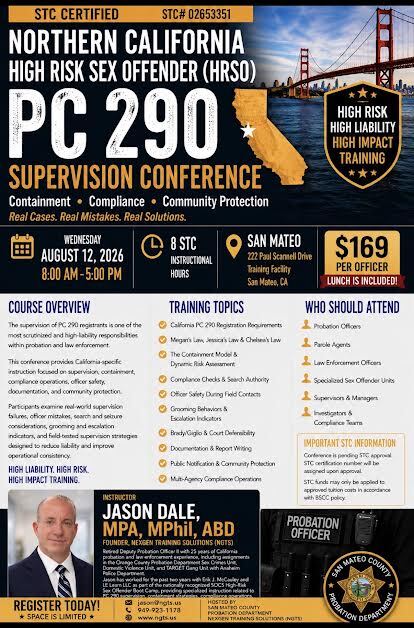
Secure your seat for the upcoming PC 290 Supervision Conference. This in-person training is designed to enhance supervisory skills, compliance knowledge, and professional development within government and agency environments.
Registration is now open. Complete your payment to confirm your seat.



Cell phone search
The real-life experience and officer-focused delivery made the training credible and effective.
Wellness course
Because he did the same job, he gets it. His honesty and vulnerability is refreshing. He made me feel comfortable about not being comfortable.
Trauma course
The instructor has his own stories about his struggles in the career, about his family, kids, and job. The delivery felt like a veteran officer coaching other officers, and it clicked.
Family Domestic Violence
He teaches in a way that respects the job and the realities we face.
Leadership
Practical and extremely relevant. He gives steps we can apply in the field.
Gangs Course
Clear instruction with real case based examples that actually match what we see in the field.
(949) 923 - 1178
jason@ngts.us